
A case study
Company Context
A founder-led startup was scaling rapidly. The energy was right, the product was proving itself, and the team was growing faster than the systems could support. What the team needed was a Chief Human Resources Officer (CHRO) who had been through this inflection point before. Someone who understood the chaos of scaling, the fragility of culture under pressure, and the cost of decisions made when everything is moving too fast.
The experience requirement was clear. Finding the right person was anything but.
The Problem
Every recruiter and recruitment platform in the market could match a keyword. CHRO. Scaling experience. Series B. Talent strategy. The shortlists came back looking technically correct but feeling entirely wrong. Time was running out.
What the team kept running into was the gap between a strong CV and culture fit. The candidates who looked strong on paper had built their careers within large, structured organizations where culture, systems, and processes were already established, not in places where they were being invented daily. The startup needed someone who understood what it felt like to make foundational decisions with incomplete information, inside a team where trust is everything and hierarchy is still being earned.
That distinction—between experience that transfers and experience that merely matches—was invisible to the traditional hiring process.
But the distinction itself is well documented. Research from Bain & Company has identified six distinct career orientations that shape how professionals approach their work: Operators, Artisans, Strivers, Givers, Explorers, and Pioneers. Each brings different strengths, motivations, and leadership styles.
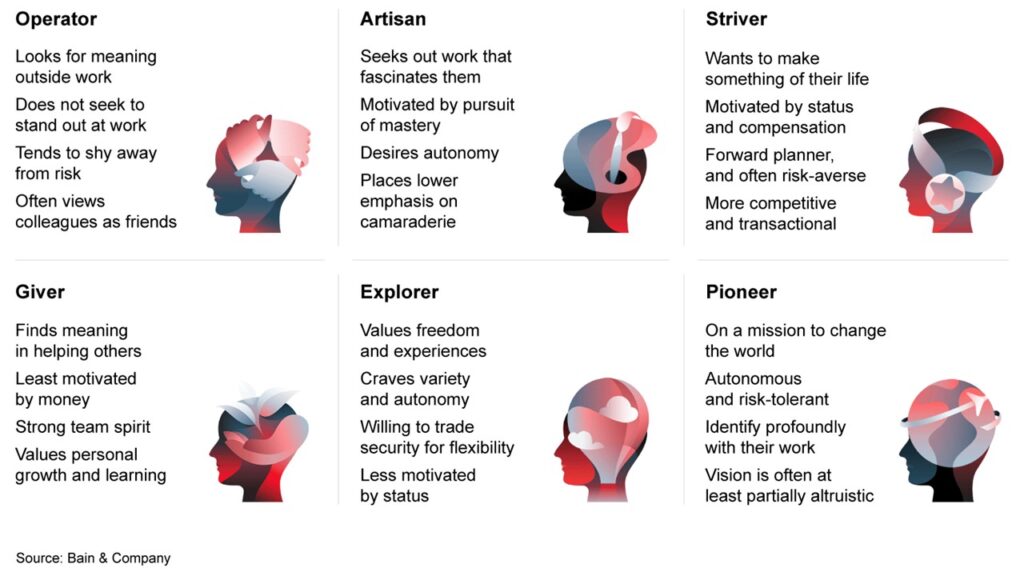
Six Career Orientations (Source: Bain & Company) — The qualities that rarely appear on a resume.
For this startup, the distinctions mattered profoundly. They needed someone who could build systems while culture was still forming, someone motivated less by status and compensation (the Striver) and more by mastery, autonomy, and the ability to shape something meaningful from the ground up (the Artisan or Pioneer). But nothing in a traditional hiring process surfaces that distinction. A keyword search cannot tell you whether someone seeks work that fascinates them or work that elevates their title. A CV cannot reveal whether someone craves variety and autonomy or prefers predictability and structure.
These orientations do not sit on a resume.
Culture fit is not a soft consideration. It is the determining factor between a senior hire who accelerates momentum and one who quietly disrupts it. Transferable skills are not obvious on a resume. They reveal themselves in conversation, in the texture of someone’s career story, in the moments of difficulty they choose to talk about and the ones they choose to leave out.
These are the things a keyword search cannot find.
Why Senior Hiring Keeps Breaking
Senior hiring has long been optimized for the wrong things. Titles. Tenures. Industry verticals. These are the signals that rise to the top of a shortlist. But for a founder-led company at a critical growth stage, the real questions were never about what a candidate had done. They were about how they had done it, why they had made the choices they made.
Shanthi Naresh, CEO of 2ndCareers, is all too aware of this gap. She saw this as a typical problem: “Senior hiring is broken in ways that most organizations have simply accepted as the cost of doing business. Extended timelines, misaligned expectations, and a process that prioritizes process over fit all contribute to a system where everyone pays more than they should and gets less than they need.”
So what does it take to close that gap?
What kind of process can look beyond credentials and accurately assess someone’s experience to determine not just competence but fit? How do you create the conditions for a hiring decision that is based on understanding rather than assumption?
And perhaps most importantly, how do you do this without adding months to a timeline that is already under pressure?
The problem is not that organizations do not want to hire well. The infrastructure for senior hiring has not kept pace with what senior hiring actually requires. The shortcuts that work for junior and mid-level roles, such as matching keywords, stacking credentials, and filtering by industry, actively work against the goal when the hire in question is someone whose judgment, perspective, and leadership style will shape the trajectory of the entire organization.
This is not a problem that can be solved by adding more steps to a broken process. It requires a fundamentally different approach.
What Actually Happened
The CHRO who eventually joined this start-up had scaling experience. But not just any scaling experience. The kind that happens when culture is still being formed and every decision carries disproportionate weight. The kind that cannot be inferred from a title or a tenure, but only from a careful reading of how someone has navigated complexity before.
The placement worked. Not because the resume was right, but because the fit was real.
This is the work that 2ndCareers was founded to solve. The work that cannot be automated, templated, or rushed. Shanthi knew this work was missing from senior hiring because she had experienced its absence herself and understood, from her own career, that the most valuable contributions a professional brings to a role are precisely the things that never appear on a resume.
The placement worked because the understanding ran deep on both sides—not just of what the role required, but of who this person was and how they would show up in the work.
