
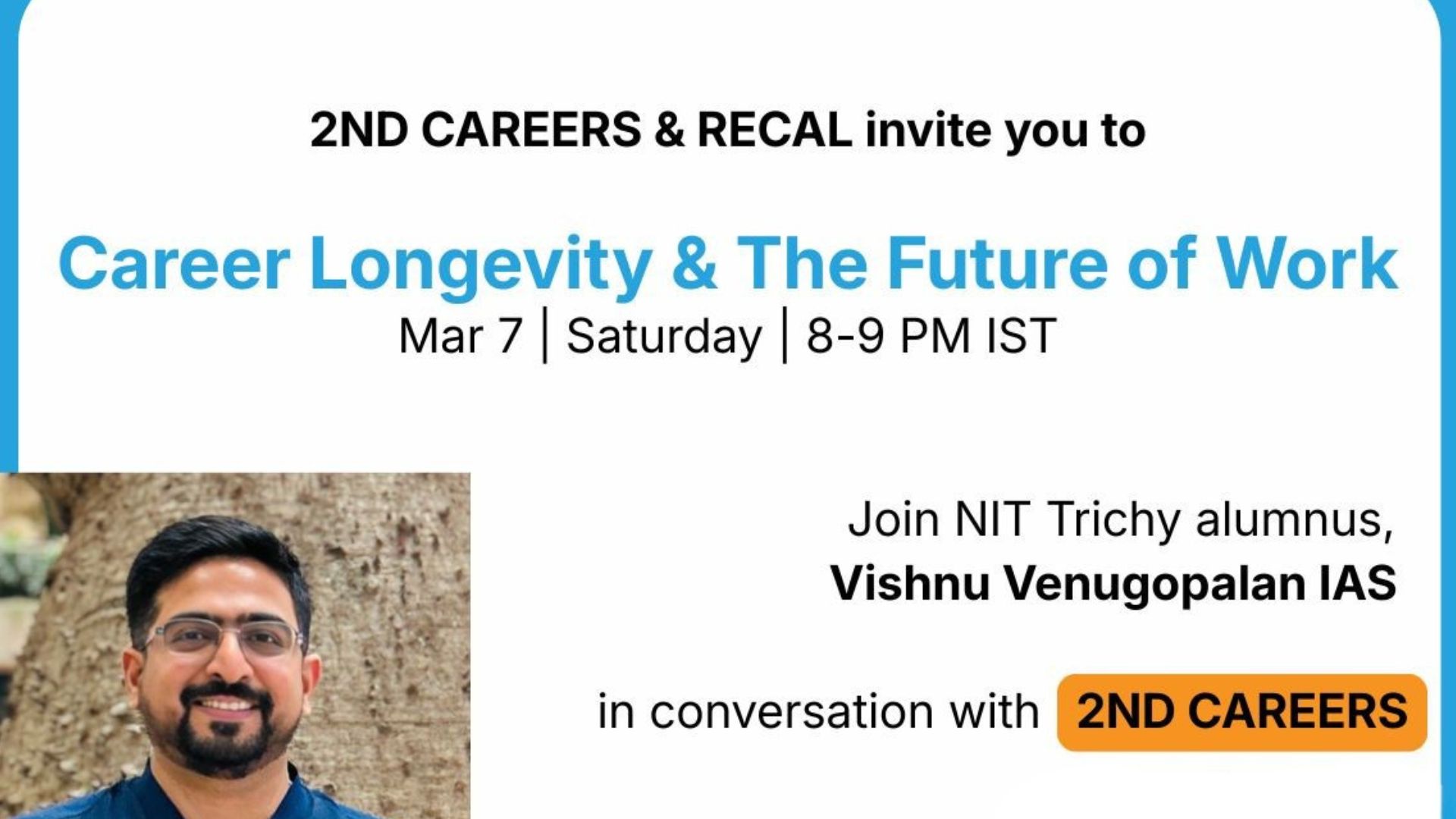
A conversation with Vishnu Venugopalan IAS, Additional Secretary, Tamil Nadu Government
At a recent fireside chat hosted by 2nd Careers and the NIT Trichy alumni network (RECAL) – Vishnu Venugopalan, IAS officer, Additional Secretary at the Tamil Nadu Government, Harvard Fellow and NIT Trichy alum – made the case that a demographic shift is underway, and policy frameworks need to catch up.
The Demographic Shift Already Underway
In the 25 years between 2000 and 2025, the share of people aged 65 and above who remain active in the labour force has roughly doubled across developed economies. In Japan, it moved from 20% to 26%. In the US, from 13% to 20%. Canada went from 6% to 15%. France, from 2% to 5%.
This is a structural trend, not a cultural quirk. People are living longer and societies are having fewer children. The global total fertility rate has been declining since 1950. The replacement rate is 2.1 births per woman. Kerala has already dropped below it. Tamil Nadu is close behind. Even high-fertility states like Bihar and UP are moving in the same direction faster than most expect.
India has long assumed its demographic dividend gives it time. Vishnu’s point is that this window is closing. The southern states in India are already on the other side of it.
The labour force will age. People will work longer. If policy does not adapt, the result is not graceful longevity. It is a large population of experienced professionals locked out of systems that were never designed to include them.
Policy Frameworks Were Built for a Different Era
India’s labour laws define workers in narrow terms: an employee in a factory, on a standard contract, working defined hours for a single employer. These definitions are increasingly out of step with a world where 85% of India’s labour force works in the informal economy. Even formal professionals are moving across consulting assignments, fractional roles, board positions, and project-based work.
Social protection follows the same logic. Provident funds, insurance, skilling subsidies all attach to the employer-employee relationship. When someone moves between employers, changes sectors, or takes a career break, they can fall out of the system. The safety net was designed for linear careers. Modern careers are rarely linear.
As Sudha Srinivasan, co-founder of 2nd Careers, put it during the session: “We are all in the longevity era. As a generation, we will live longer than any prior generation of humanity. With long life, it is also important to have longevity of careers.” The policy question is whether our systems are built to support that.
Vishnu’s argument is that the unit of protection must shift from the job to the individual.
Areas Where Policy Can Make a Real Difference
- Build a portable benefits system on India’s digital public infrastructure. India has one of the most capable DPI stacks in the world. The Aadhaar-based architecture already enables identity verification at scale. The opportunity is to use it to create a portable benefits system where social security travels with the person. A professional moving from a corporate role to an advisory position to a teaching stint should carry their entitlements across. The infrastructure exists. The regulatory frameworks need to follow.
- Enable cross-sector mobility. The UGC’s Professor of Practice framework is a concrete example. For decades, entering higher education required a PhD and formal academic credentials. That has changed. Experienced professionals from industry can now teach in universities without those barriers. This kind of regulatory reform, applied more broadly, enables people to reinvent themselves without starting from scratch. Korea’s labour market information system, which treats employment as a dynamic and seasonal phenomenon rather than a fixed state, offers another model worth studying.
Watch the full recording on YouTube
Beyond Skills: The Deeper Adaptation Challenge
Vishnu made a point that deserves more attention than it usually gets in policy circles.
“This is not a skills problem,” he said. “It is a psychological adaptation problem.”
Governments can fund reskilling. Platforms can offer courses. The deeper challenge is that work has become the primary organising identity of modern life. People define themselves by their job title, their company, their sector. When that changes, the loss is not just financial. It is existential.
Sushma Srinivasan, co-founder of 2nd Careers, put it plainly: “You have to let go of what you have put as a box around yourself in framing your identity. Unless you let go of that, the vast, infinite possibilities that lie beyond that box will not be accessible to you.”
Vishnu noted that pre-industrial societies organised themselves around kinship, craft, and community. The question facing us now is not whether meaningful life is possible beyond a traditional career. History is clear that it is. The question is how societies navigate the transition period between the old structure and the new one still being built.
For governments, the policy brief extends beyond labour law and social security. It includes how education systems build adaptive mindsets, how communities support people through transitions, and how the cultural narrative around work and retirement gets updated for a 90-year life.
Building Policy for the Longevity Era
As Sushma noted, the shift in mindset needs to start earlier than most people expect. “Start thinking about what you’re going to do when you’re 40, 45. Don’t wait till 60.” The same urgency applies to policy.
Vishnu ended with a question, not an answer. What gives meaning when work, as we have known it, changes? That question sits above the policy levers, the labour law reforms, and the DPI architecture. It is a question for societies, not just governments.
But societies respond to incentives. Incentives are shaped by policy.
If India’s labour frameworks continue to treat the experienced professional as an afterthought, the longevity era will arrive as a problem. If governments move early on portable benefits, flexible work protections, and cross-sector mobility, the same demographic shift becomes a reservoir of capability the economy can draw on for decades.
What should public policy prioritise in the longevity era? We’d love to hear your perspective, whether you are a professional navigating this transition, an employer adapting to it, or a policymaker thinking through the frameworks.
Read our whitepaper to explore how future-ready organisations can begin responding to these shifts today: Building Future-Ready Organisations for a Longevity Era
